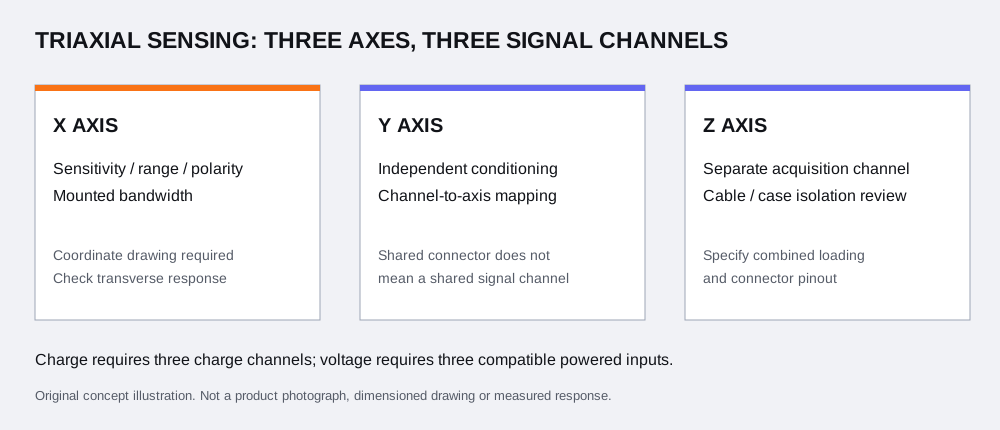
Capture three orthogonal components with an explicit axis convention. Review each channel’s sensitivity, range, polarity and mounted response before matching the acquisition system.
Content reviewed
PZA-TRI / SELECT A REQUEST PROFILE
Choose a charge or voltage request for three independent axes.
Each PZA identifier describes a configuration to quote. The requested targets below remain subject to supply, drawing and calibration review.
PZA-TRI-15C
15g three-axis charge request
Three charge channels with explicit axis polarity and mounting coordinates.
Requested output / axes
Charge · pC/g · 3 axis / 3 channels
Connection review
Three-channel breakout / individual outputs
15g mass target
2.8 pC/g nominal request per axis
Three separate charge channels; connector layout to confirm
Check X, Y and Z as independent measurement chains.
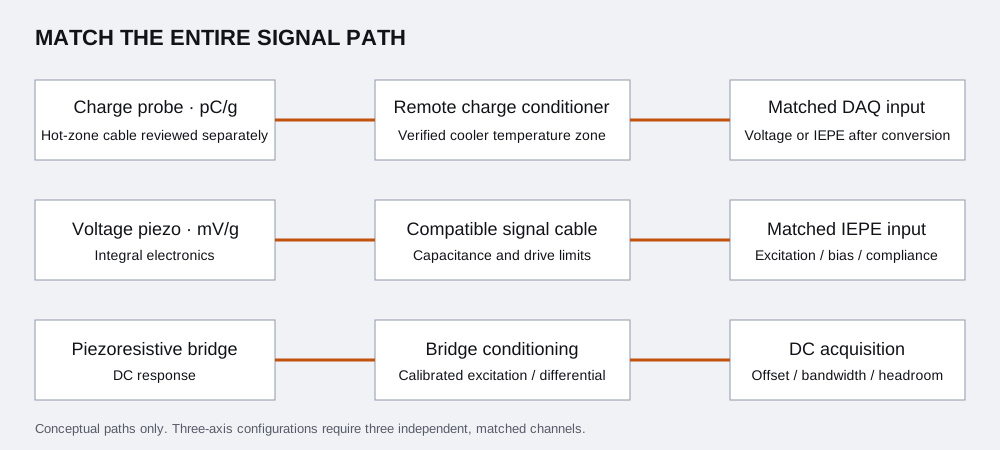
A three-axis package is not a single electrical channel. For charge output, reserve three charge-conditioning channels. For voltage output, reserve three compatible powered inputs. A breakout cable must preserve the exact pin-to-axis mapping.
Review sensitivity and usable bandwidth for each axis. The original PCB 356A01 page, for example, distinguishes the X-axis frequency range from Y/Z. Do not assign the largest published frequency to all three axes.
Specify axis orientation, mounting coordinates, transverse sensitivity, case/ground isolation and combined loading. A high-temperature voltage request needs confirmation of the integral electronics limit; choose a charge review if that limit is exceeded.
Original engineering concept. Any numerical example is illustrative; actual hardware and installed performance require confirmation.
Can one inline converter condition a triaxial charge sensor?
One channel cannot condition three independent signals. Request three matched charge channels and the correct breakout or individual connectors.
Does PZA-TRI-01V include the same rating on every axis?
The identifier is a request profile. Each axis’s sensitivity, flat band, polarity and calibration must be confirmed in the proposed datasheet.
What drawing is needed for a three-axis installation?
Provide the mounting surface, coordinate convention, connector clearance and cable route. Ask for the proposed controlled envelope and pinout before fixture release.
Confirm the PZA-TRI output before connecting the DAQ.
Conceptual signal paths. Actual electrical and thermal limits require a configuration review.
PZA-TRI / QUOTE & CAD
Send the PZA-TRI configuration, channels and document scope.
Accessories are optional quotation requests. Selection and final pricing follow the electrical, mounting and temperature review.
CAD / CALIBRATION / QUOTATION
Request the documents that close the engineering review.
Independent axis sensitivity/polarity, transverse sensitivity, mounting coordinates and cable pinout.
Controlled datasheet & CAD
Ask for the quoted configuration, revision, complete dimensions, tolerances, mounting thread, cable and connector. STEP availability is confirmed against that exact configuration.
Calibration & traceability scope
State reference frequency, amplitude, excitation and temperature. Request available sensitivity, capacitance, transverse response and frequency/temperature records. A named calibration standard alone is not a test result.
Formal quote / PI inputs
Include sensor and channel counts, accessories, calibration scope, destination, delivery window and required documents. Prices and availability are confirmed in the quotation.
No released PZA CAD, measured certificate or commercial quote is supplied by these concept pages. Select the required documents in the RFQ; we will confirm what can be provided for the proposed configuration.