CHARGE · SHEAR · DC SHOCK[email protected]
PZAQUARTZ & CERAMIC DYNAMICS
05 / Charge → Voltage → DAQ

Charge preamplifiers & in-line converters

Match the conditioner to the sensor’s hot-state insulation, charge level and measurement window. Request PZA-422 inline conversion for a compatible IEPE input, or adjustable laboratory charge amplification for a voltage input.

Content reviewed

PZA-AMP / SELECT A REQUEST PROFILE

Choose conversion gain or laboratory control.

Each PZA identifier describes a configuration to quote. The requested targets below remain subject to supply, drawing and calibration review.

PZA-422-100

100 mV/pC inline conversion request

Match input charge, polarity, hot-state source resistance and DAQ compliance.

Requested output / axes
Charge conditioning · instrument
Connection review
Single-ended coaxial charge path
  • 100 mV/pC requested conversion gain
  • Input charge and output swing confirmed together
  • Inverting / non-inverting request after polarity review
Original references and differences to review
PCB 422E11 ↗

The general 422E converter is not automatically suitable for low sensor resistance at high temperature.

Request PZA-422-100 ↗
PZA-422-10

10 mV/pC inline conversion request

Match input charge, polarity, hot-state source resistance and DAQ compliance.

Requested output / axes
Charge conditioning · instrument
Connection review
Single-ended coaxial charge path
  • 10 mV/pC requested conversion gain
  • Input charge and output swing confirmed together
  • Inverting / non-inverting request after polarity review
Original references and differences to review
PCB 422E12 ↗

Exact gain and swing checked in the original manual; hot-state input resistance still needs review.

Request PZA-422-10 ↗
PZA-422-01

1 mV/pC inline conversion request

Match input charge, polarity, hot-state source resistance and DAQ compliance.

Requested output / axes
Charge conditioning · instrument
Connection review
Single-ended coaxial charge path
  • 1 mV/pC requested conversion gain
  • Input charge and output swing confirmed together
  • Inverting / non-inverting request after polarity review
Original references and differences to review
PCB 422E13 ↗

The general 422E converter is not automatically suitable for low sensor resistance at high temperature.

Request PZA-422-01 ↗
PZA-2635-LAB

Adjustable laboratory charge-amplifier request

Review gain, low-frequency time constant, filters and any integration functions.

Requested output / axes
Charge conditioning · instrument
Connection review
Connector / topology to review
  • Adjustable charge sensitivity normalization request
  • Voltage output and filter settings to confirm
  • Displacement/velocity integration only if included in the quoted instrument
Original references and differences to review
B&K 2635 ↗

These original functions are requests to review for PZA, not confirmed included features.

Request PZA-2635-LAB ↗
PZA-AMP / INSTALLATION DECISION

A conversion gain is useful only inside both input and output limits.

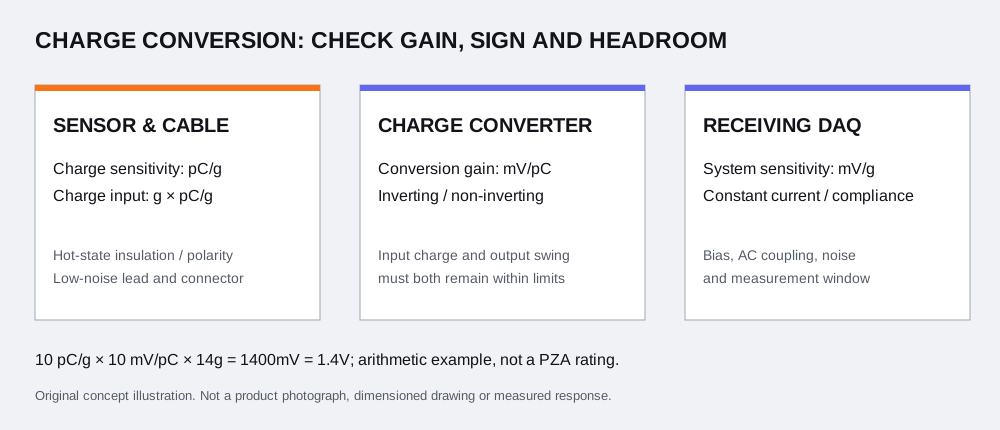
System sensitivity is sensor pC/g multiplied by converter mV/pC. Peak output also includes peak g. Check the converter input-charge limit as well as output voltage swing, bias and DAQ compliance; a gain calculation alone cannot approve the chain.

The 100, 10 and 1mV/pC PZA identifiers are gain requests. Other gains, including 0.5 and 0.1mV/pC, can be described in a custom request. Input charge, bandwidth and source resistance cannot be copied from a different gain or original-model suffix.

Polarity must be read from the exact sensor and conditioner specifications. For example, the original 357B03 page states negative output, while the 2221F sheet states positive output for acceleration into the base. Request an inverting or non-inverting path after checking the coordinate convention.

A laboratory instrument may offer adjustable gain, filters, time constants or integration. Ask which functions are included in the proposed PZA-2635-LAB configuration; an original B&K feature list is not proof of supplied PZA functions.

Charge sensitivity, conversion gain, polarity and receiving DAQ headroom checked as one chain
Original engineering concept. Any numerical example is illustrative; actual hardware and installed performance require confirmation.
Is a standard 422E reference suitable for every hot charge probe?

No. Some general converters have minimum source-resistance requirements. Hot sensor insulation and the exact converter specification must be reviewed together.

Can a converter connect to any IEPE DAQ?

Verify excitation current, compliance voltage, bias, output swing, frequency response and connector. An interface name alone does not establish compatibility.

How do I request a three-channel chain?

Select the three-axis sensor profile and request three matched conditioning channels. State the gain and polarity per axis, the breakout cable and the receiving inputs.

Read the original-model reference and approval checks →

PZA-AMP / CONFIGURATION REVIEW

Define the test envelope.

Remote conditioning of high-temperature charge sensors and laboratory vibration measurement chains.

Requested options for review — these are configuration targets, not released specifications.
Inline requestPZA-422 charge-to-IEPE converter; gain, input charge and output swing to confirm
Laboratory requestAdjustable gain and filtering; requested voltage output up to ±10 V by configuration
Gain conventionmV/pC; inverse sensitivity pC/mV must be identified explicitly

Range, temperature, sensitivity and bandwidth combinations require model-specific confirmation, controlled drawings and calibration requirements.

Before you select

  1. Check input charge and voltage headroom separately; g × pC/g × mV/pC gives mV.
  2. Confirm current supply, compliance voltage, bias, noise and discharge time constant.
  3. Place electronics in a verified temperature zone; distance from the probe alone is not a temperature rating.

Original-model review candidates
PCB 422E family; B&K 2635 / Nexus; Kistler charge-conditioning references

Review replacement criteria →

Confirm the PZA-AMP output before connecting the DAQ.

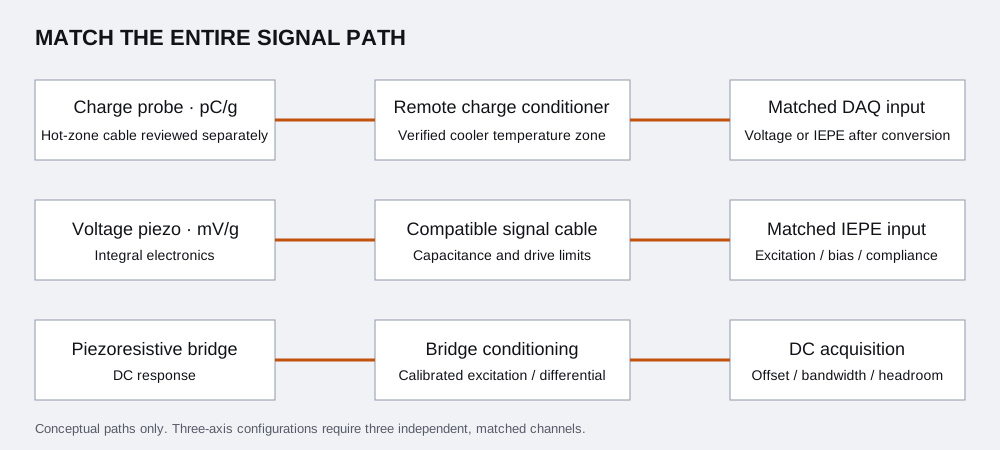
Three separate chains: charge sensor to remote charge amplifier or converter, voltage sensor to IEPE input, and piezoresistive bridge to excitation and differential DC input
Conceptual signal paths. Actual electrical and thermal limits require a configuration review.
PZA-AMP / QUOTE & CAD

Send the PZA-AMP configuration, channels and document scope.

Accessories are optional quotation requests. Selection and final pricing follow the electrical, mounting and temperature review.

PZA engineering request
Optional accessories — quote by configuration

State the sensor output, source resistance, gain, channel count and receiving DAQ input.

Documents to request
Open prefilled email ↗

Current request: PZA-AMP custom configuration. Changing output, topology or temperature may require a custom review.

Email [email protected]. If your desktop mail app shortens a long brief, use copy or download. No attachments are uploaded by this form.

Preview the complete engineering brief
PZA engineering RFQ
Name: Not provided
Company / lab: Not provided
Reply email: Not provided
Family: PZA-AMP
PZA request profile: Unspecified
Sensing technology: Charge conditioning only
Output: Charge conditioning
Axes / peak g: Specify in test brief
Independent channels: To confirm
Local operating temperature: Cryogenic / other — specify local temperatures
Conditioning: Review the existing DAQ / need advice
Connector / topology: Connector / topology to review
Converter polarity: review
Original model: Not provided
Original source: No exact original reference matched; manual review
Reference status: No exact source match
Quantity: 1
Source: /charge-preamplifiers-in-line-converters
Optional accessories: None
Documents requested: None
No PZA hardware configuration assumed.
Configuration review only; compatibility, temperature, calibration, prices and delivery require confirmation.
Test brief:
Not provided
CAD / CALIBRATION / QUOTATION

Request the documents that close the engineering review.

Charge input limit, gain/polarity, output swing, noise, source resistance and time constant.

Controlled datasheet & CAD

Ask for the quoted configuration, revision, complete dimensions, tolerances, mounting thread, cable and connector. STEP availability is confirmed against that exact configuration.

Calibration & traceability scope

State reference frequency, amplitude, excitation and temperature. Request available sensitivity, capacitance, transverse response and frequency/temperature records. A named calibration standard alone is not a test result.

Formal quote / PI inputs

Include sensor and channel counts, accessories, calibration scope, destination, delivery window and required documents. Prices and availability are confirmed in the quotation.

No released PZA CAD, measured certificate or commercial quote is supplied by these concept pages. Select the required documents in the RFQ; we will confirm what can be provided for the proposed configuration.

Request CAD and calibration scope ↗