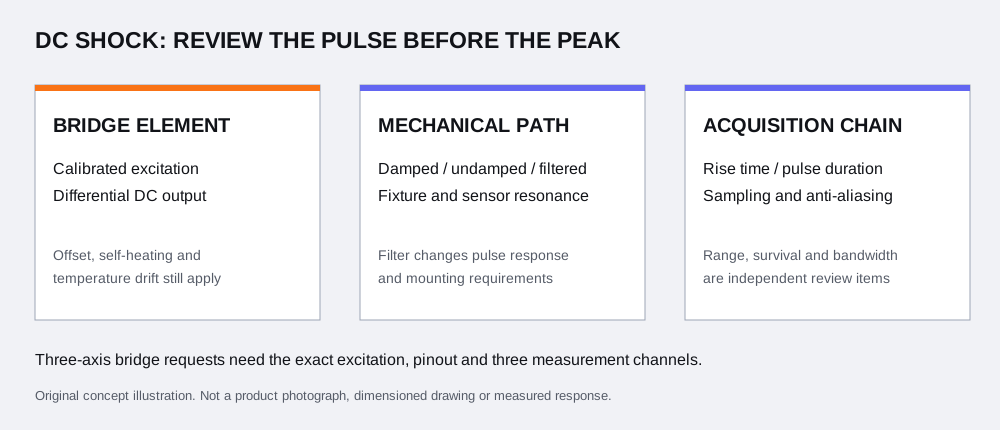
For a long pulse or a measurement that must include DC, review a piezoresistive bridge sensor with matched excitation and differential conditioning. Peak acceleration alone does not define a shock measurement.
Content reviewed
PZA-PRZ / INSTALLATION DECISION
DC response, damping and pulse fidelity must agree.
A piezoresistive bridge can retain DC response, but excitation, zero offset, temperature drift and self-heating still affect the measurement. Use the excitation at which the proposed calibration is performed and a suitable differential DC input.
Peak g alone is insufficient. State pulse duration, rise time, shock spectrum, required flat band and anti-aliasing. A mechanically filtered configuration changes the pulse response and mounting; an undamped high-resonance reference is not a universal substitute for a damped crash channel.
Review the seismic-mass coordinates, mounting footprint, cable lead colors and torque against the actual controlled drawing. A shunt check verifies an electrical path under specified conditions; it does not replace an acceleration calibration. PZA-7270-Z is a zero-output fixture request with resistance and excitation still to confirm.
Original engineering concept. Any numerical example is illustrative; actual hardware and installed performance require confirmation.
Can a charge amplifier condition a piezoresistive bridge?
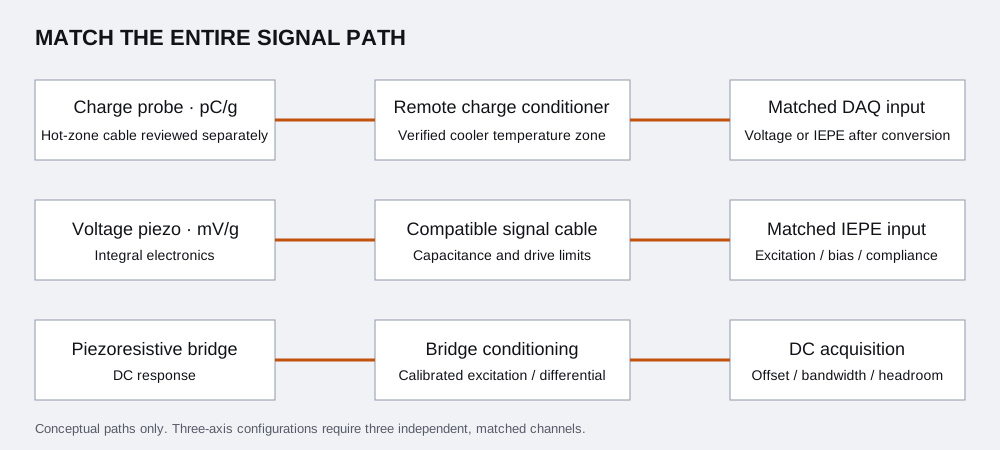
No. The bridge needs calibrated excitation and a differential DC measurement path. Charge amplifiers condition a different signal type.
Does DC response guarantee zero drift during a long pulse?
No. Review offset, temperature, excitation stability and the full measurement window. Distinguish true acceleration from an electrical zero change.
Is the ±60,000g entry a released PZA rating?
It is a feasibility request beyond the core ±50,000g planning range. Measurement range, pulse conditions, survival and calibration must be confirmed separately.
Confirm the PZA-PRZ output before connecting the DAQ.
Conceptual signal paths. Actual electrical and thermal limits require a configuration review.
PZA-PRZ / QUOTE & CAD
Send the PZA-PRZ configuration, channels and document scope.
Accessories are optional quotation requests. Selection and final pricing follow the electrical, mounting and temperature review.
CAD / CALIBRATION / QUOTATION
Request the documents that close the engineering review.
Bridge excitation, pulse duration, damping, seismic-mass coordinates, lead colors and mounting torque.
Controlled datasheet & CAD
Ask for the quoted configuration, revision, complete dimensions, tolerances, mounting thread, cable and connector. STEP availability is confirmed against that exact configuration.
Calibration & traceability scope
State reference frequency, amplitude, excitation and temperature. Request available sensitivity, capacitance, transverse response and frequency/temperature records. A named calibration standard alone is not a test result.
Formal quote / PI inputs
Include sensor and channel counts, accessories, calibration scope, destination, delivery window and required documents. Prices and availability are confirmed in the quotation.
No released PZA CAD, measured certificate or commercial quote is supplied by these concept pages. Select the required documents in the RFQ; we will confirm what can be provided for the proposed configuration.