Protect the mode you are trying to measure. Start with local modal mass, the required mounted bandwidth and cable restraint, then choose sensor mass and a charge or voltage output.
Content reviewed
PZA-MIN / INSTALLATION DECISION
Sensor mass is only one part of the mass-loading problem.
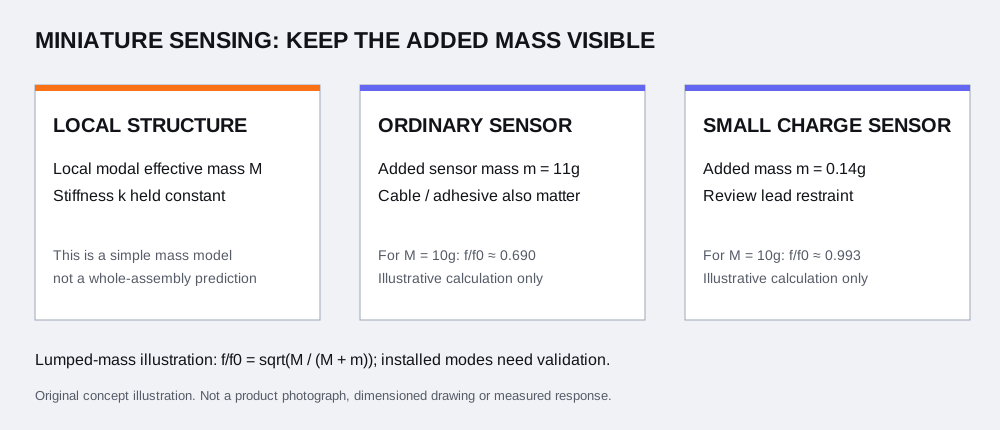
Use local modal effective mass rather than total assembly mass. In the simple illustration, stiffness is held constant and added mass changes frequency in proportion to sqrt(M/(M+m)). For M=10g, adding 11g gives a ratio of about 0.690; adding 0.14g gives about 0.993. This is a calculation, not a prediction for your component.
Include adhesive, mounting base and the moving part of the lead in the review. Keep the lead restrained without loading the measured mode. A sensor-only mass excludes cable mass and cannot guarantee an unchanged natural frequency.
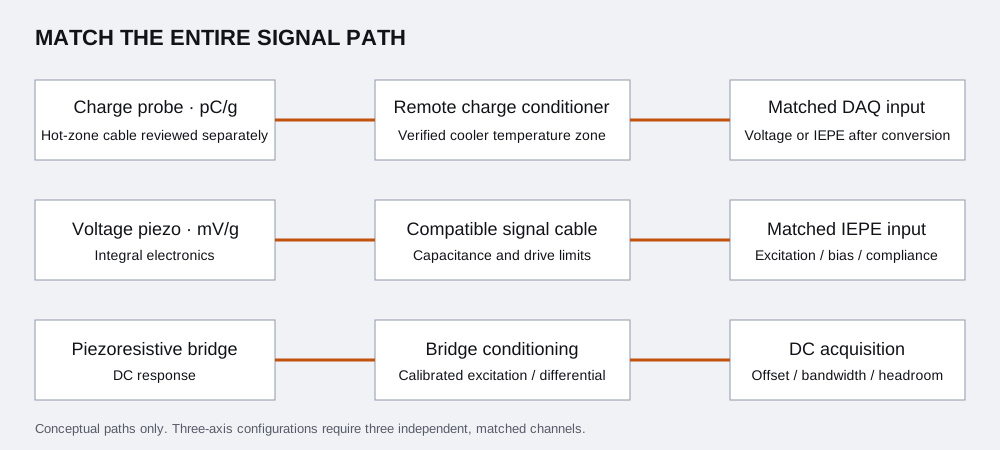
Charge and voltage miniature sensors need different conditioning. Identify an integral or replaceable micro lead before ordering an extension cable. The 2.4g high-temperature charge request is a separate configuration from the sub-gram voltage requests.
Original engineering concept. Any numerical example is illustrative; actual hardware and installed performance require confirmation.
Does a 0.14g sensor eliminate mass loading?
It reduces one source of added mass. The local mode, adhesive, mounting base and cable restraint still affect the installed measurement.
Is the 60kHz resonance a 60kHz usable measurement band?
No. Specify a flatness tolerance and mounting method for the usable band. Resonance and flat response are separate quantities.
Can a miniature voltage sensor use an external charge converter?
The integral electronics already provide voltage output. Use a compatible powered voltage/IEPE input; an external charge converter belongs to a charge-output chain.
Confirm the PZA-MIN output before connecting the DAQ.
Conceptual signal paths. Actual electrical and thermal limits require a configuration review.
PZA-MIN / QUOTE & CAD
Send the PZA-MIN configuration, channels and document scope.
Accessories are optional quotation requests. Selection and final pricing follow the electrical, mounting and temperature review.
CAD / CALIBRATION / QUOTATION
Request the documents that close the engineering review.
Sensor-only and lead mass, adhesive interface, mounted response and micro-cable connection.
Controlled datasheet & CAD
Ask for the quoted configuration, revision, complete dimensions, tolerances, mounting thread, cable and connector. STEP availability is confirmed against that exact configuration.
Calibration & traceability scope
State reference frequency, amplitude, excitation and temperature. Request available sensitivity, capacitance, transverse response and frequency/temperature records. A named calibration standard alone is not a test result.
Formal quote / PI inputs
Include sensor and channel counts, accessories, calibration scope, destination, delivery window and required documents. Prices and availability are confirmed in the quotation.
No released PZA CAD, measured certificate or commercial quote is supplied by these concept pages. Select the required documents in the RFQ; we will confirm what can be provided for the proposed configuration.